One piece
An article
Limit
Up to 1,200 words
For organisations hiring a copywriter or content writer
Your new hire is weeks away and the work in the ad won’t wait. I write it in the meantime, in your voice and from your own material, with every fact shown next to its source.
You read the first piece before you pay anything. If you don’t approve it after two rounds of changes, you owe nothing and the copy can’t be used.
GBP 450 {USD 595 | EUR 525} for the first piece, with a one-page voice guide and a handover note for your new hire. Everything happens by email, with no calls.
Want to see my writing on your ad first? Get a free opening: a headline and about 150 words
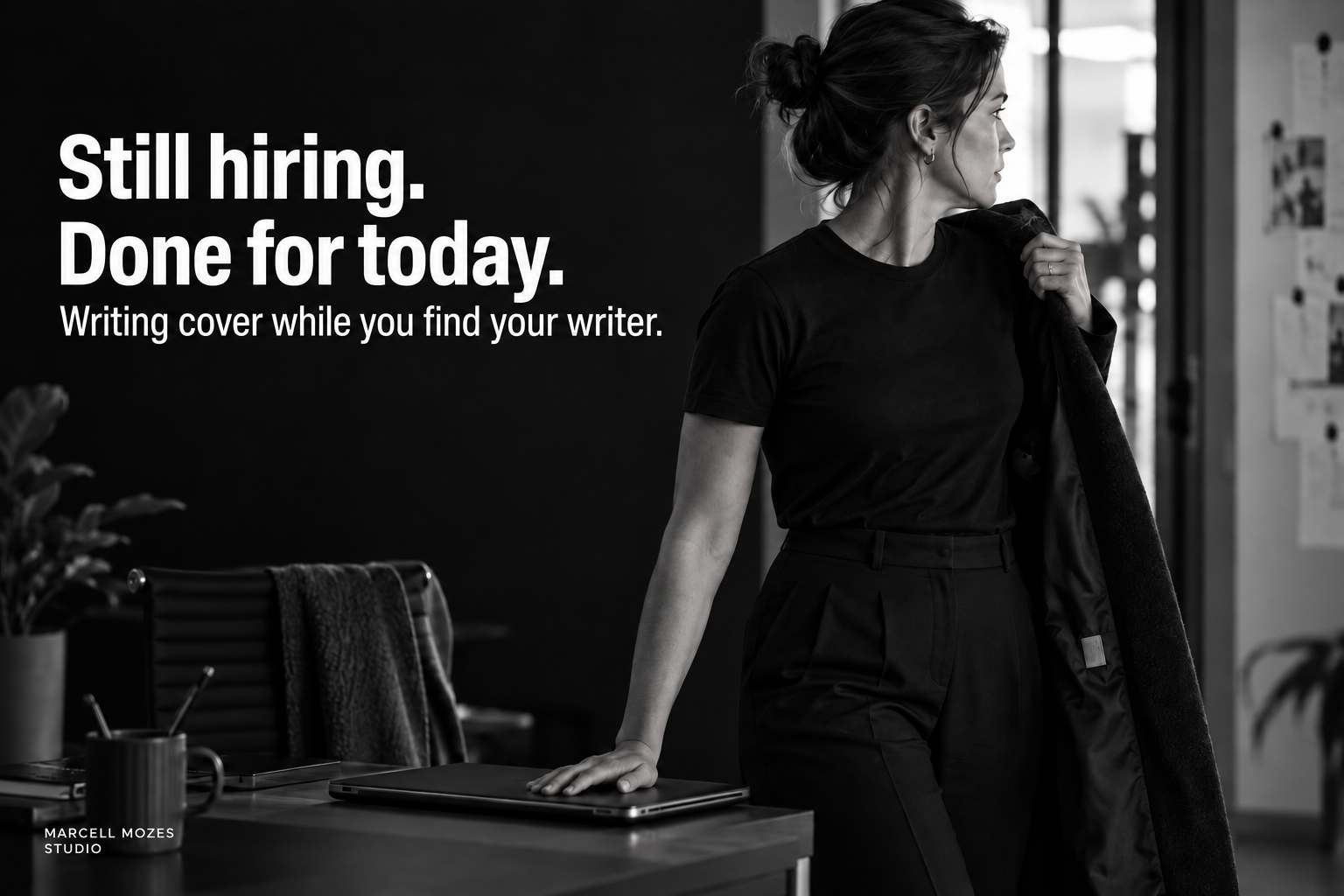

I’m not applying for the role. I cover the writing until your hire starts.
Marcell Mozes, Warrington, UK
01 · Where you are now
Maybe the newsletter has slipped a month. Maybe you’re writing the product pages yourself after six, and the case studies are still notes in a folder.
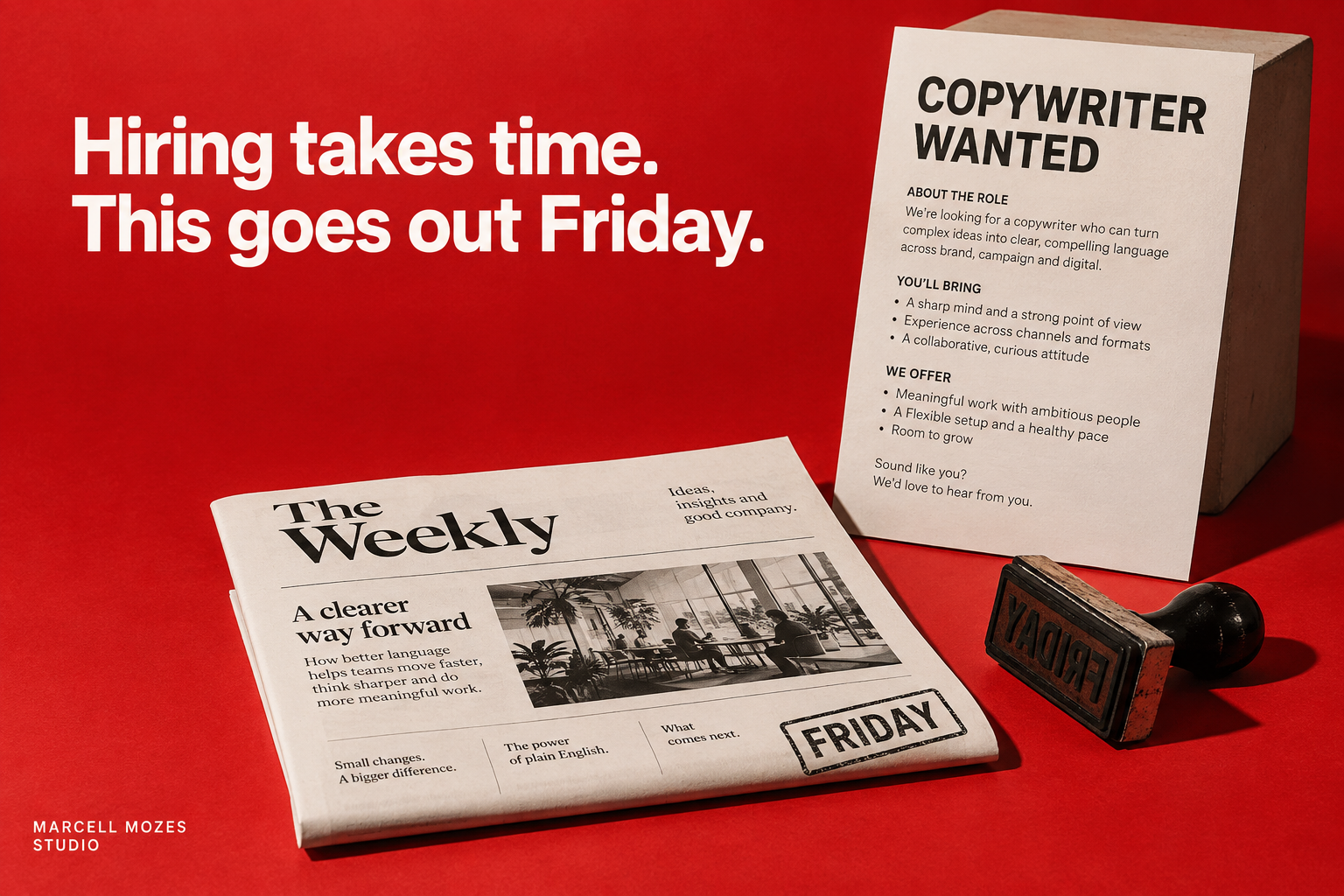
Hiring takes the time it takes, and if the person you choose is employed now, they work their notice first. Every week the seat is empty, that work either slips or comes out of someone’s evenings. Your new hire then starts with a backlog instead of a plan.
02 · What you stop doing
03 · What one piece is
You pick the piece from your ad. Each of these counts as one:
A longer piece counts as two, and I say so in writing before I start.
04 · See the work
The brief is your job ad. The voice comes from your site and three links you send that sound like you.
Every document carries one of three labels: Draft (the first version, with open questions marked), Facts confirmed (every “to confirm” answered) and Approved (the final version you approved).
“Two destination guides a month.”
Four days in the Lakes, no car needed
Most people think you need a car for the Lakes. You don’t. The train from Oxenholme brings you to Windermere, and from there the 555 bus and the lake steamers link the villages you came for. This guide plans four days around them: where to stay so every morning starts on foot, and which walks finish at a bus stop rather than a car park.
| Line | Source |
|---|---|
| The train from Oxenholme brings you to Windermere | northfell.example/getting-there |
| the 555 bus ... link the villages | northfell.example/routes/central-lakes |
| the lake steamers | To confirm: your site lists summer sailings only. Do they run in October? |
Your hire inherits all of it: the approved pieces, the voice guide and the handover note.
What editors at agencies I’ve written for say about working with me.
“What I appreciated most was his rigor. If something in the source material was ambiguous, he flagged it rather than guessing.”
 Joe Gowdridge, Pretzl
“The best compliment I can give Marcell is that I didn’t have to rewrite his draft.”
05 · How starting works
If the complete brief doesn’t arrive within 14 days of your booked start date, the place is released and you can book again later.
The start date in my reply is the next one I can keep.
Editors at agencies I’ve written for
“He understood the positioning, stayed within the scope, and delivered exactly when he promised.”
 Barnaby Ellis, Director, Strategy & Experience, Fifty Five and Five
06 · Prices
Both prices are public, so you can set them against any other quote before you start.
GBP 450 {USD 595 | EUR 525} for one piece from your ad
Invoiced only when you approve it.
GBP 1,500 {USD 1,950 | EUR 1,750} for 4 pieces from your ad, every 4 weeks
In short: four pieces from your ad each cycle, less per piece than the first piece, paid in advance, and you stop with 7 days’ notice.
The block runs on my Desk, which is how I book ongoing work by the cycle. The Desk opens only after your first job is approved and paid.
If you book the block within 14 days of approving your first piece, that piece becomes piece one of the block. Block total GBP 1,500 {USD 1,950 | EUR 1,750} for 4 pieces, which includes the first piece you already paid. You pay the rest, GBP 1,050 {USD 1,355 | EUR 1,225}, for the other three. The block then starts on the first UK working day after both the first piece and the block balance are paid.
Prices are totals. Prices are fixed in USD, GBP and EUR. Your invoice is in the currency you choose on the start form. Invoices can be paid by card or bank transfer.
07 · How paying works
Full wording in the Terms and Refunds.
Editors at agencies I’ve written for
“What I appreciated most was knowing where things stood without having to chase.”
 Rachel Osborne, Senior Account Manager, Blend
08 · How I work
I’m Marcell Mozes, a UK copywriter. You deal with me from the first line to the invoice, not an account manager. I reply within 1 UK working day. Questions? Email marcell@marcellmozes.com
This isn’t for you if you need someone in the office, want interviews or calls, or are a recruiter filling a client’s role.
09 · Questions
Paying after you approve is open to any organisation with a live website and an email address on its own domain, once per organisation. You don’t need to be a limited company. Sole traders are welcome when they get in touch with me first.
Then your hire starts with the first piece done and the handover note. You only book more if you want it.
You can choose the larger option when you start, or within 14 days of approving your first job. What you paid for the first job counts in full. Choosing it at the start is not a commitment: the block is booked and invoiced only after your first piece is approved and paid.
I use AI for research and first drafts. I check and edit every line myself. The free opening is the test. How I use AI
Whoever you name on the form. If a director has to approve the spend, say so under What you need.
The form asks, but it isn’t a condition for starting, and a PO or supplier set-up doesn’t hold up the writing. Put your PO number in the start form’s purchase order field, or send it later with your brief, and it goes on the invoice. I return supplier forms within 1 UK working day.
Publishing counts as approval, so I send the invoice. If copy goes live by mistake and comes down within 5 UK working days, I cancel the invoice.
You’re buying finished pieces from an independent supplier: no set hours, no line management, and I work on my own equipment. I’m a sole trader, not a limited company, so I don’t work through an intermediary. Whether any rule applies to your case is for your accountant to confirm. This is not legal or tax advice.
From 14 days overdue, statutory interest and the fixed recovery fee apply. At 30 days overdue, the licence to use the copy ends.
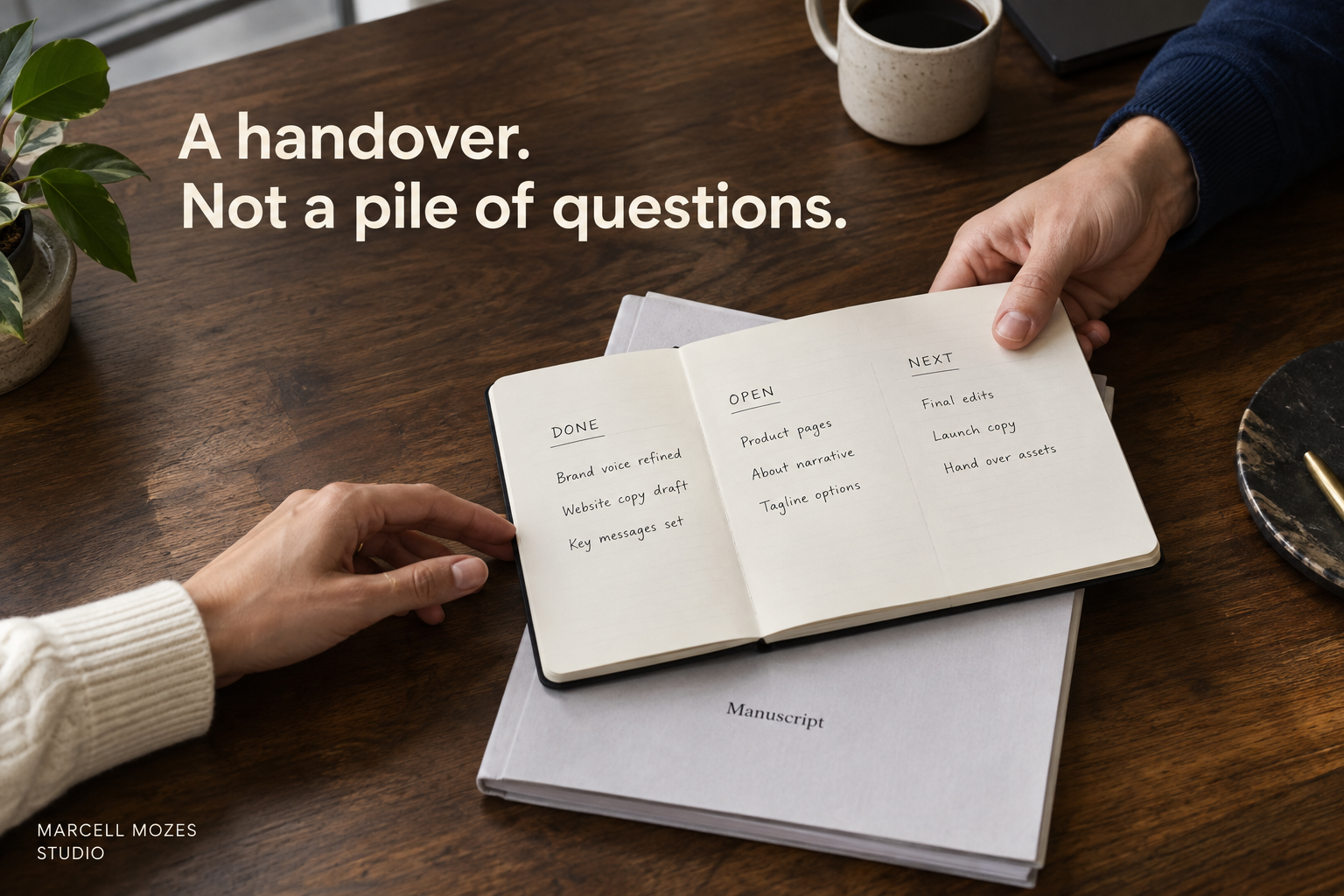
The handover note is one page that comes with your first piece: what is done, what is open, what comes next. The handover pack comes with a block cycle, once your hire’s start date is set and at least one full cycle is paid.
A headline and about 150 words opening one piece from your ad, with a source column, within 1 UK working day. It is headed “Draft sample. Not licensed for use.” One free sample per organisation. Nothing to pay for the sample. The Terms still cover how we use each other’s material. Get the free opening
10 · Your first piece
Questions first? Email marcell@marcellmozes.com and I reply within 1 UK working day.