“Can we try one more direction?”
A new review round enters after the agreed feedback cycle.
ScopeSignal explores a focused way to handle scope change: turn every material request into a visible commercial choice before the team keeps delivering.
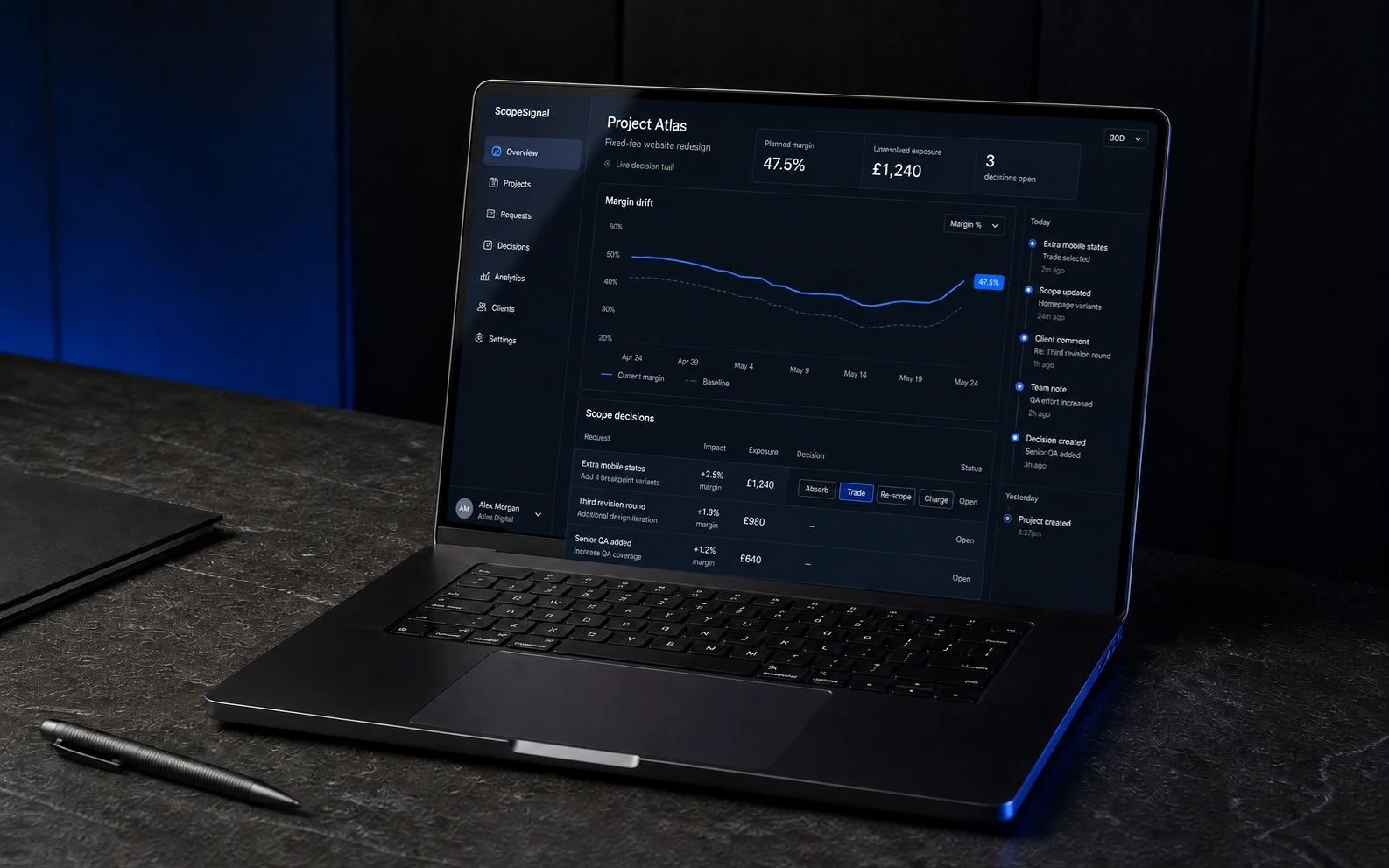
The distinction
Some requests are worth absorbing. Some should replace other work. Some require a new plan or fee. The loss of control begins when delivery continues before anyone chooses.
Market context is directional. This page demonstrates positioning and conversion architecture, not validated product demand or outcomes.
How margin disappears
It arrives inside normal delivery language. Each request appears small enough to keep moving. The commercial effect only becomes obvious after several decisions have already been made by default.
A new review round enters after the agreed feedback cycle.
A useful improvement appears without a matching scope decision.
The delivery mix changes, but the original cost assumption stays untouched.
The team protects momentum. The project quietly accepts the cost.
The expensive part is not the request. It is delivery continuing before the commercial decision.
The problem mechanism
Work can remain operationally “on track” while commercial control slips. The project plan records tasks; the missing object is the explicit choice attached to the deviation.
It appears in chat, email, feedback or a project-management task.
Someone estimates effort informally, or simply begins because the request feels reasonable.
The request is not explicitly absorbed, traded, re-scoped or charged.
Time and internal cost accumulate across requests that looked harmless alone.
The agency discovers the effect later—even though no one consciously approved it.
The solution object
Not another vague alert. A short record connecting what was agreed, what changed, the estimated commercial impact and the response an authorised person chose.
Capture the fee, scope and planned delivery cost.
Preserve the deviation in the client’s and team’s words.
Show the delivery cost and cumulative exposure.
Absorb, trade, re-scope or charge—before work continues.
Create an accountable internal and client-ready summary.
Visibility is not the same as a decision.A margin warning can show that something changed. It cannot establish who chose the commercial response or why.
The proposed distinction is decision accountability.The concept is intentionally narrower than project management, time tracking or financial forecasting.
Future image 02 / Mechanism transition
Recommended: a close, editorial product-detail image focused on one commercial choice—not a second hero, generic office photograph or repeated analytics screen.
Four valid responses
The useful outcome is a conscious choice appropriate to the relationship, the project and the economics.
Absorb
Accept the delivery cost because the goodwill or strategic value justifies it.
Make the cost visible anyway.Trade
Add the request while removing something of comparable delivery cost.
Reset what “done” includes.Re-scope
Pause the request until timing, ownership or deliverables are agreed again.
Do not let ambiguity become approval.Charge
Price the additional work and obtain approval before delivery continues.
Make the client’s choice clear.Where the concept sits
Agency platforms already market forecasts, live margins and budget alerts. Scope tools already document requests, impact and approvals. ScopeSignal’s narrower hypothesis is the explicit four-way commercial decision.
PSA / Agency operations
Projects, people, time, budgets, utilisation, forecasting and broader business reporting.
Centre of gravity: operational visibilityScope / Change-order tools
Compare requests with scope, estimate impact, create change orders and retain approvals.
Centre of gravity: change controlScopeSignal concept
Connect the deviation to one of four explicit responses and preserve the decision rationale.
Working distinction: decision accountabilityThis is a positioning hypothesis, not a superiority claim. Whether the distinction can support a standalone product would still require interviews, feasibility work and market testing.
A deliberately narrow hypothesis
The concept is designed around fixed-fee or capped agency work. It cannot rescue unclear scope, unreliable inputs or a culture where nobody owns commercial decisions.
Designed for
Not a substitute for
Product truth
Questions
No. Absorbing work can be the right commercial decision. The concept makes the choice and its estimated effect visible instead of allowing it to happen silently.
No. It is an independent product and conversion-copy concept created to demonstrate B2B SaaS research, positioning, page architecture and execution.
That has not been established. A real product would need discovery around inputs, integrations, human review, accuracy and false positives.
No. The concept is framed as a focused decision workflow. Whether it should be a standalone tool, feature or process template remains unresolved.
Because art direction should support the page hierarchy. The two reserved positions define what each image must do before visual production begins.
The decision before the next task
Every material change deserves one visible commercial response before the work continues.